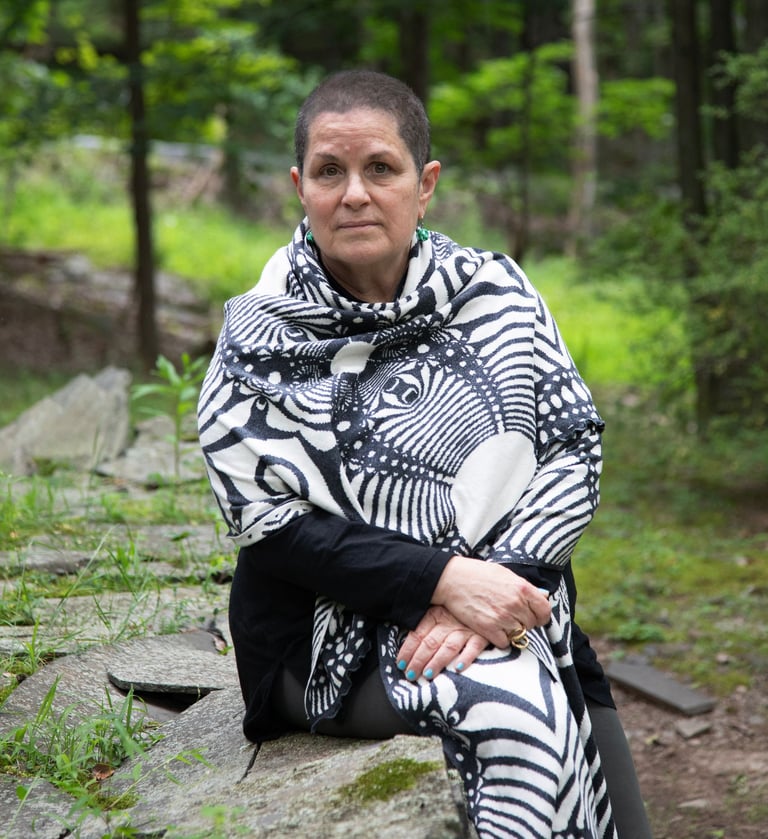
Photograph by Don Freeman
BIO/ARTIST STATEMENT
BIO
Raghubir Kintisch (b. 1955, New York, NY) is a multidisciplinary artist exploring the intersection of spiritual and creative practices. Their richly textured oil paintings on paper emerge from collage and pattern-based sketches, reflecting themes of alternative universes, nature, and the inner mind. Kintisch holds a BFA in Painting from the Rhode Island School of Design and an MFA in Social Practice from Otis College of Art and Design.
Kintisch exhibited at MoMA (2017–2018 Club 57: Film, Performance, and Art in the East Village, 1978–1983), La Foret Museum (Tokyo), Launch Gallery, LAXART, Keystone Art Gallery, Robert Berman Gallery, Merry Karnowsky Gallery, Armory Center for the Arts, Winslow Garage, Kleinert-James Gallery (Woodstock, NY), Proxy Gallery, MutMuz Gallery, Angels Gate Cultural Center, and Tryst Art Fair (Torrance), among others. A Byrdcliffe Artist-in-Residence for four consecutive years from 2022–2025, Kintisch received Pollock-Krasner Foundation funding in 2023 and was awarded a Silver Sun Foundation Residency in 2021. Recent works include diptychs, triptychs, mixed-media collage, and India ink tonal paintings, featuring vibrant color, texture, and patterning. Kintisch lives and works in Los Angeles, CA.
ARTIST STATEMENT
Painting for me is both a visual and contemplative practice. Through repeated acts of observation and transformation, I am interested in whether sustained attention can alter perception. My paintings begin with observed imagery, often botanical forms, photographs, or earlier paintings, but they are not attempts to represent the visible world. They are inquiries into what prolonged looking allows us to see. Working through cycles of fragmentation, recombination, and repainting, each image gradually departs from its source. As forms are repeated, enlarged, mirrored, and reimagined, unexpected relationships emerge while descriptive information falls away. Rather than pursuing a predetermined composition, I allow each painting to evolve through a process of discovery in which intuition and material transformation become collaborators.
What begins as observation slowly becomes psychological, atmospheric, and associative. The paintings occupy a threshold between recognition and abstraction, where memory, sensation, and imagination coexist. I think of this iterative process as analogous to contemplative practice: each return to the image becomes another opportunity to see differently.
Ultimately, my work asks how abstraction might operate as a form of mysticism, not as an escape from the world, but as a way of encountering aspects of experience that lie beyond immediate perception. The paintings are less concerned with arriving at a fixed image than with creating conditions in which seeing itself becomes transformative.